Plaster, drywall and ceilings
Drywall Repair in Oil City, PA
Cracked plaster, punched-in holes, tea-colored water rings and ceilings that drooped after an ice dam, put back flat, textured to suit the room and primed for your roller.
Ring or text, sketch out the trouble, and a plaster-and-drywall pro nearby calls you to go over it and name a price.
Call 7 days, 7am–9pm
Oil City houses: plaster-era walls on most streets
The town boomed at a bend in the Allegheny, right where Oil Creek pours in, after the first wells went down in 1861, and the housing still shows it. Census estimates for the 2020-2024 period put the city's housing at 4,603 homes. Of those, 2,697 were already standing by the end of 1939, which is more than half. Only 517 went up from 1980 onward.
So what's behind your paint? A pre-war house was nearly always finished with plaster troweled over thin wood lath, because sheetrock didn't catch on until after the 1940s. Plenty of old houses get a mix over the decades: the parlor still in its original plaster, the kitchen or the attic bedroom redone in drywall. Whoever repairs it has to know which one they're dealing with before talking price.
Detached one-unit houses make up 3,400 of the city's homes, and another 583 are in two-unit buildings. Renters live in 1,514 of the 3,908 occupied homes. If you own a rental, the gap between leases is a good window for closing anchor holes, dings and that dent behind the bedroom door. Downtown, the North Side and the South Side each have a historic district on the National Register, and the region promotes its Victorian architecture to visitors, so it pays to ask for a patch that respects old trim and plaster lines.
| Built | Homes | Share of homes |
|---|---|---|
| 1939 or earlier | 2,697 | |
| 1940s | 231 | |
| 1950s | 518 | |
| 1960s | 238 | |
| 1970s | 402 | |
| 1980s | 243 | |
| 1990s | 87 | |
| 2000s | 86 | |
| 2010s | 74 | |
| 2020 or later | 27 | |
| All homes | 4,603 |
Plaster cracks: tape, skim or new board?
Got an old plaster wall with cracks in more than one spot? You've basically got three roads, and which one fits hangs on whether the plaster is still gripping the lath behind it. Press gently with your palm beside a crack. If it gives a little, or you hear a gritty crunch, that part has let go, and tape over the top won't hold for long.
| Point to weigh | Tape and fill the cracks | Skim-coat the whole wall | Cut out and fit new board |
|---|---|---|---|
| Leaves trim and casing alone | Yes | Yes | Sometimes has to come off |
| Deals with plaster pulling off the lath | No, it only hides it | Once it's screwed back | Yes, the loose part goes |
| Dust in the room | Light | Moderate | Heaviest |
| Return trips for coats and drying | Two or three | Three or more | Two or three, plus tear-out |
| Sensible for a single crack | Yes | Usually overkill | No |
The short version: a handful of cracks in firm plaster is a tape-and-fill job. A wall crazed with spidery lines but still solid is a fine candidate for skimming. A section that has bellied out goes, and new board gets furred out to match the old depth. Lots of rooms in town end up with a bit of each, and your quote should spell out which part of the wall gets which treatment.
Repair types: the five we book in town
Just about every wall headache in an Oil City house lands in one of these. Can't tell which is yours? A snapshot usually answers it.
Old plaster walls
Loose, bulging or crumbling plaster screwed back, filled and smoothed without gutting the room.
Plaster and lath repair in Oil CityCracks overhead and on walls
Settling cracks over doorways, splits along ceiling joints and seam lines, opened up and reinforced.
Fixing wall and ceiling cracksCeilings hit by winter leaks
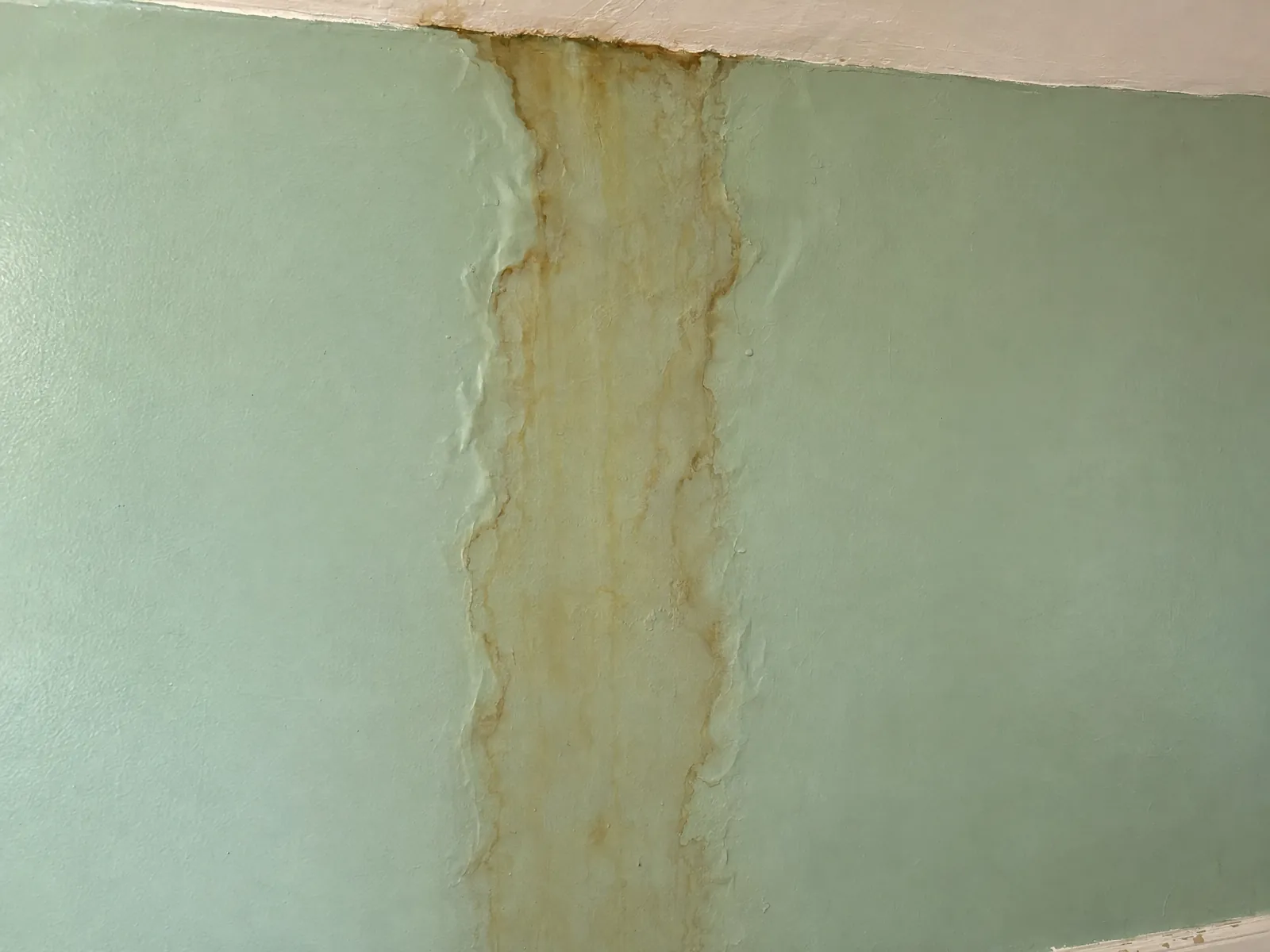
Stained, drooping or soaked ceilings near the eaves after a thaw, dried out and rebuilt.
Ceilings hurt by ice damsSoaked basement board
Swollen, stained or musty lower-level walls trimmed back above the wet mark once things have dried.
Water-damaged basement drywallHoles, dents and corners
Doorknob punctures, anchor holes, bashed corners and move-out dings closed up and blended in.
Patching holes in drywall
Living with the repair: grit, waiting and paint
Sanding grit
Joint compound, once sanded, becomes a talc-fine dust that hangs in the air. Poly sheeting plus a dust-collecting sander, or a wet sponge in place of sandpaper, catch most of it, but plan on wiping down nearby shelves afterward.
Overnight waits
Joint compound gets applied thin, several times over, and each pass needs to dry out before the next. Fast-setting mixes cut the wait; plaster base coats on old walls stretch it. A muggy basement in July slows everything.
Coming back for coats
One small patch can sometimes be wrapped up in a single trip. Anything bigger usually means a couple of return visits spread over a few days, since the layers need to cure.
Color on top
Fresh primer goes over the patch so the topcoat doesn't dry dull over it. Dabbing paint on just the patched spot tends to flash, since the old color has faded, so plan on rolling that whole wall from corner to corner.
Under raking light
Sun skimming down a hallway can pick out bumps on any wall, repaired or not. Feathering the compound out wide keeps the patch flat, which makes it far harder to spot.
After the electrician: closing holes other trades leave
Rewiring an old house, running a new drain, adding a duct or pulling data cable to a home office all tend to leave the same calling card: a string of rough openings in walls and ceilings. That's normal. The electrician is there for the wiring, not the plaster.
Closing those openings right means squaring off the ragged edges, adding wood or metal backer where there's nothing to screw into, fitting a piece of board or plaster base at the correct depth, then taping, coating and feathering it into the wall around it. On plaster, the patch often needs shims so its face lines up with the old surface, which is rarely the same thickness as modern board.
Two pointers if you're mid-project. Asking the electrician or plumber for clean rectangular openings, wherever they can manage it, makes the closing-up cheaper. And if an inspector still has to look at the work, hold off on covering anything until they've signed off, so no hole gets opened twice.
Your call to a paint-ready wall: how the job moves along
Tell us about it
Dial us from the phone link up top, fill in the request page, or text a couple of pictures of the damage with a soda can parked beside it so its size is obvious.
Price it on the phone
We hand your details to a drywall tradesperson based nearby in Venango County. They phone, ask a handful of questions and quote the job. Nothing starts until that figure gets a thumbs-up from you.
Choosing when
We help book a date that suits your week, whether that's a weekday morning or a slot that fits around school pickup.
Patching day
The damaged area is opened up as far as it needs to go, backed, filled, coated, sanded and primed, with the surrounding texture reproduced.
Your turn with the roller
You end up with a smooth, primed area waiting for your paint, or finished in color too if painting was included in the price.
Want the longer version? Read how Oil City Drywall Repair handles a job.
Around the river: neighborhoods and towns we cover
Inside city limits, that's everywhere from the North Side down through downtown and over the river to the South Side. Past the city line:
Siverly and the North Side
Siverly ran its own borough council until it merged into the city in 1910. The Oil Well Supply works sprawled along the river there and put up company houses for its workers by the 1910s.
Rouseville
A small borough roughly three miles north-northeast of downtown, incorporated in 1900.
Franklin
The Venango County seat, about seven miles west-southwest, where French Creek empties into the Allegheny.
Seneca and Cranberry Township
Seneca is one of two census-designated communities inside Cranberry Township, sitting a straight-line 3.5 miles south of downtown.
View service area for Reno, Cranberry Township and the full list.
Small, medium, large: what changes as the damage grows
Small
Nail holes, anchor holes, a chair-back ding, a hairline crack. Spackle or a little mesh square, two skim passes, a light sanding and spot primer. Often one trip.
Bob Vila's drywall guide, citing Fixr, says a pro charges at least $75 for small holes 4 inches across or smaller.
Medium
A doorknob puncture, a chewed-up outside corner, a stain about as wide as a skillet. The bad piece is cut out square, backer strips go behind, a replacement piece is screwed in, and it gets three coats with a dry-out between each, so usually two trips.
That guide also gives $200 to $550 as a national figure for several holes and cracks in one room.
Large
A ceiling section that came down after a leak, a wall of loose plaster, a basement wall cut back after water. Full sheets, more coats, re-texturing and often paint. Several trips across a week or so.
Big jobs swing too widely for a fair published range, so the quote is built from the factors below.
What nudges a quote up or down, whatever the size: plaster or drywall, how high the ceiling is and how easy it is to reach, whether a texture has to be copied, how many separate damaged places you've got, whether things need to dry out first, and paint or no paint. Those national figures aren't Oil City prices; the number from the pro who quotes your wall is the one that counts.
Garage and cellar walls: moisture, dents and Type X
Lower-level walls take a beating from water. Drywall framed in front of a foundation can wick moisture up from the slab, and the river flats around town can flood after ice jams, heavy snowmelt or big storms. If the board feels spongy, has puffed up or smells like a damp cellar, the honest advice is to hold off. It needs to dry out and read normal on a moisture meter before replacement board goes up, or the new piece will rot the same way.
A sound basement repair trims the soaked board out well above the highest wet mark, gives the studs time to dry, looks for mold, and puts back a moisture-resistant panel kept just clear of the concrete.
Attached garages bring their own rules. The wall and ceiling shared with the house are often Type X, the fire-resistant kind of board, and a repair there should go back with Type X too, with every opening sealed up so the separation still works. The other garage problem is plain impact: car doors, bikes and the mower handle all leave dents and punctures at the same heights.
More on that: drying out and replacing wet basement board.
Protecting the room: floors, vents and doorways
Before any compound comes out, floors near the work should be covered with canvas or rosin paper, furniture slid back or draped in plastic, and the room's heating and cooling registers taped over. It's worth asking for the furnace blower to stay off while sanding is going on, so dust doesn't ride the ductwork into every bedroom upstairs.
Bigger jobs often get a zippered poly sheet stretched floor to ceiling across the doorway, so the hallway never sees the grit. A shop vac hooked up to the sander grabs most of the grit right at the wall.
What helps from your side: clear knickknacks off nearby shelves and walls, keep kids and pets out of the room while work is going on, and mention any fussy hardwood or old woodwork when you chat with the pro.
Newer houses: nail pops and gaps at the ceiling line
Newer houses are scarce in Oil City; those 517 built from 1980 on work out to about one in nine. If yours is one of them, or you're just outside town in something more recent, the wall problems look different from old plaster.
Nail pops show up as little dimes of raised paint, sometimes with a ring cracked around them, where a nail worked itself loose while green lumber dried out. The usual fix drives a screw just beside the nail, pulls the board snug, and coats over both.
Truss uplift is a gap that opens right where a partition wall butts into the ceiling, often widening in winter and closing up again in summer as the roof trusses bow with the attic's moisture. Hard compound won't hold there. The usual cure lets the ceiling float at that corner, using a slip-joint bead or crown molding nailed to the ceiling only, so the movement has room.
Seeing a ceiling gap like that? Our ceiling guide walks through what it means.
Next move: show us the damage
Been eyeing a crack all winter, or patching a dent from last weekend's furniture shuffle? Send a snapshot or give us a ring and we'll get things rolling.
One chat on the phone with a nearby pro, and you have a number for the job before a single screw goes in.